
Last updated: 13 August 2026 (Get a Japanese Visa in South Africa)
Reviewed by: Road2Asia Visa & Document Services
Information verified against: Embassy of Japan in South Africa and Ministry of Foreign Affairs of Japan
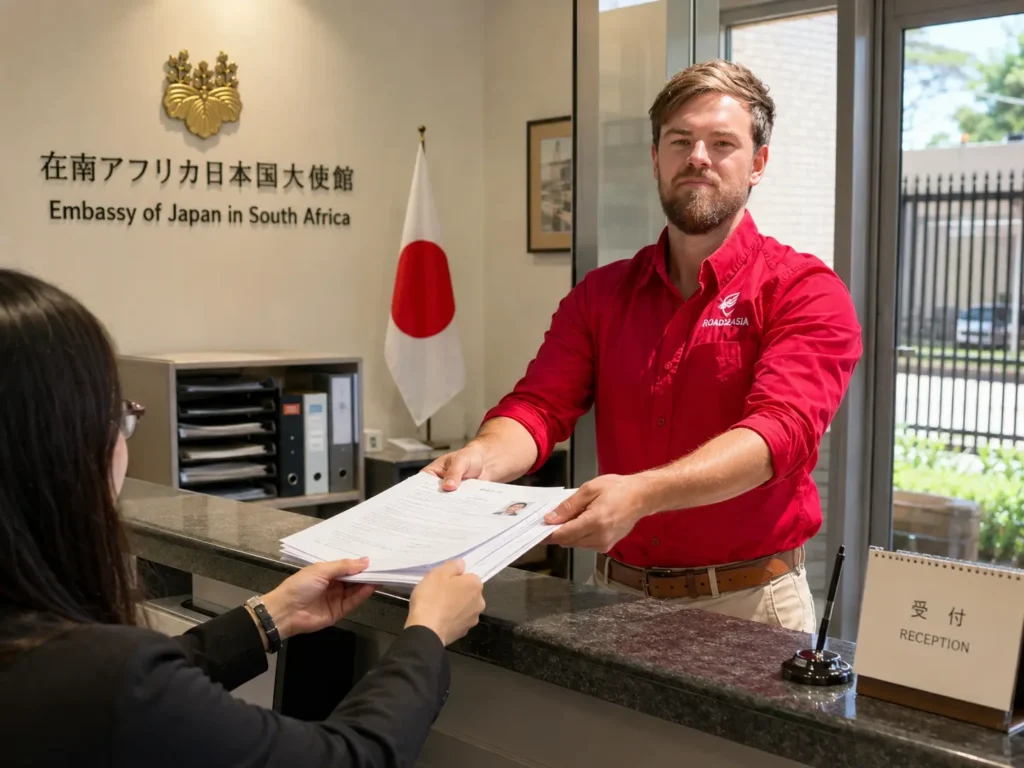
For a straightforward Japanese visa application submitted in South Africa, the standard processing time is five working days from the day after the application is accepted, provided there are no problems with the application. Japan’s Ministry of Foreign Affairs specifically uses this five-working-day period as its standard visa-processing benchmark.
In practical terms, applicants should think of this as approximately one working week after acceptance, rather than assuming that five days starts from the moment they begin completing an application online. Japan’s current short-term visa documentation also describes normal processing as approximately one week.
However, five working days is not guaranteed. Applications requiring additional documentation, an interview or further examination can take considerably longer — sometimes several weeks or even months.
Japan Visa Processing Time at a Glance
| Application situation | Typical official guidance |
|---|---|
| Straightforward visa application | 5 working days from the day after acceptance |
| Simple short-term application | Approximately 1 working week |
| Application requiring additional examination | Several weeks to several months possible |
| Case referred to MOFA in Tokyo | More than 1 month possible |
| Long-term/work application without Certificate of Eligibility | Typically 1–3 months |
| Tourist eVisa | Use the 5-working-day standard as a planning baseline, but delays remain possible |
| Guaranteed express service | No guaranteed expedited decision simply because departure is approaching |
Japan’s Ministry of Foreign Affairs says applications are processed in the order received and specifically warns that an approaching departure date does not allow the authorities to make a decision before the required examination has been completed.
How Long Does It Take to Get a Japanese Visa in South Africa?
The standard answer is:
Five working days from the day after the Japanese authorities accept the visa application.
For example, if an application is formally accepted on a Monday and there are no intervening public holidays, the five-working-day examination period begins from the following working day.
This does not mean every Japanese visa will be issued within exactly five working days.
Japan’s Ministry of Foreign Affairs states that the standard processing period applies when there are no problems with the contents of the application. If further checks are required, processing may take from a couple of weeks to several months.
The safest way to interpret the timeframe is therefore:
5 working days = normal examination period, not a guaranteed maximum turnaround time.
When Does the 5-Working-Day Processing Period Start?
This is an important distinction.
The official five-working-day period runs from the day after the application has been accepted, rather than necessarily from the moment an applicant starts preparing documents or creates an online eVisa application.
For an online application, incorrect information or incomplete supporting documents can lead to delays or cancellation before the application proceeds normally. The Embassy of Japan in South Africa specifically warns that incorrect information or inadequately uploaded documents can delay examination or result in an eVisa application being cancelled.
Road2Asia Practical Tip
Do not calculate your travel plans by simply counting five working days backwards from your flight.
You must also allow time for:
- preparing documents;
- correcting incomplete information;
- appointment availability where a physical submission is required;
- weekends;
- South African public holidays;
- Japanese Embassy holidays;
- additional-document requests; and
- unexpected further examination.
For practical travel planning, Road2Asia recommends allowing substantially more than the official minimum whenever possible.
How Long Does a Japan Tourist eVisa Take From South Africa?
Japan currently allows eligible applicants residing in South Africa to apply online for a single-entry short-term tourism visa for a stay of up to 90 days through the JAPAN eVISA system.
The Ministry of Foreign Affairs’ general standard visa-processing period remains five working days from the day after acceptance where there are no problems with the application.
However, applicants should not assume that submitting an eVisa application today means the visa will necessarily appear exactly five calendar or working days later.
An eVisa application can take longer if:
- uploaded documents are incomplete;
- information needs to be corrected;
- additional documentation is requested;
- the applicant is asked to attend an interview; or
- further examination is required.
The eVisa system therefore makes submission more convenient, but does not remove the underlying visa examination process.
Who Can Apply for a Japan eVisa in South Africa?
As of May 2026, the Ministry of Foreign Affairs lists South Africa as one of the countries of residence where eligible foreign nationals can use the JAPAN eVISA system.
The eVisa route currently applies to:
- ordinary passport holders;
- applicants who require a short-term visa;
- residents of eligible countries including South Africa;
- short-term tourism;
- single-entry applications; and
- intended stays of up to 90 days.
The online eVisa route does not currently cover all purposes of travel.
Applicants travelling for purposes such as:
- visiting relatives or friends;
- business;
- study;
- work;
- transit; or
- other long-term purposes
must generally follow the applicable paper visa procedure through the Japanese diplomatic mission rather than using the tourist eVisa route.
South African ordinary passport holders are not included in Japan’s current ordinary-passport short-term visa exemption list, so South Africans normally require a visa before travelling to Japan.
When Can a Japan Visa Take Longer Than 5 Working Days?
There are several situations in which processing can exceed the standard period.
Additional Documents Are Requested
Japan may request further documents after an application has been accepted if additional information is required to assess the applicant’s circumstances. Until the requested documents are submitted, the examination cannot continue normally.
An Interview Is Required
Applicants may be asked to attend an interview as part of the examination process. This can also occur with an eVisa application even though the normal eVisa process is conducted online.
Further Examination in Tokyo Is Required
If there is a problem with the contents of an application, the Embassy or Consulate-General may refer the application to Japan’s Ministry of Foreign Affairs for further examination.
In such cases, visa issuance can take more than one month.
Large Numbers of Applications
Japan also warns that the normal five-working-day processing period can become longer when a large volume of applications is received over a short period.
Long-Term Visa Without a Certificate of Eligibility
For applicants travelling to Japan for work or another long-term purpose, submitting an application without a Certificate of Eligibility can substantially extend processing.
Japan’s Ministry of Foreign Affairs states that visa issuance without a Certificate of Eligibility typically takes one to three months.
How Long Does a Japan Work Visa Take in South Africa?
The visa-stage processing time for a Japanese work visa depends heavily on whether the applicant already has a Certificate of Eligibility (COE).
Japan recommends that applicants travelling for work or long-term residence obtain a COE from the relevant immigration authority in Japan before applying for the visa.
| Work visa situation | Processing implication |
| Certificate of Eligibility available | Normally allows the visa application to be processed more smoothly |
| No Certificate of Eligibility | Typically 1–3 months |
| Additional examination required | Can take longer |
| Incomplete application | Processing may be delayed until information is supplied |
The Embassy of Japan in South Africa confirms that applicants intending to work, study or live in Japan should in principle first obtain a Certificate of Eligibility through a sponsor in Japan.
What Is a Certificate of Eligibility?
A Certificate of Eligibility, commonly abbreviated as COE, is issued through Japan’s immigration system before many long-term visa applications.
For applicants in South Africa, the application is normally initiated in Japan by an appropriate sponsor, such as:
- an employer;
- school;
- university;
- spouse; or
- other eligible sponsoring organisation or person.
Obtaining a COE before the visa application generally helps the visa and immigration examination proceed more efficiently. However, possession of a COE does not guarantee that a visa will be issued.
How Early Should South Africans Apply for a Japanese Visa?
Japan’s Ministry of Foreign Affairs specifically advises applicants to apply well in advance of their anticipated travel date because applications requiring additional examination can exceed the standard five-working-day period.
A single-entry Japanese visa is generally valid for three months from its date of issuance, meaning the traveller normally needs to enter Japan before that validity expires.
Road2Asia Recommendation
For an ordinary tourist application, Road2Asia recommends aiming to have the application process underway approximately three to four weeks before departure, rather than relying on the five-working-day minimum.
For:
- work visas;
- study visas;
- family-related visas;
- complicated applications; or
- applications requiring documentation from Japan,
allow considerably more time.
The objective is not merely to receive the visa before departure. It is to leave enough time to correct a problem without placing the entire trip at risk.
Can You Pay for Express Japan Visa Processing?
Applicants should not assume that an official guaranteed express visa service exists simply because their departure date is approaching.
Japan’s Ministry of Foreign Affairs states that it cannot decide whether to issue or refuse a visa until the necessary examination has been completed and that applications are processed fairly in the order received.
An urgent flight therefore does not automatically move an application ahead of others or remove the examination requirements.
This is another reason to submit the application early.
Where Do You Apply for a Japanese Visa in South Africa?
The application route depends on the purpose of travel.
Tourism
Eligible applicants residing in South Africa can apply online through the JAPAN eVISA system for a single-entry tourist visa covering a stay of up to 90 days.
Other Visa Categories
Applicants who do not qualify for the tourist eVisa route must use the relevant Embassy or Consular Office application process.
| Applicant / application | Main route |
| Eligible short-term tourist | JAPAN eVISA |
| Business visitor | Paper application |
| Visiting family/friends | Paper application |
| Work visa | Paper application |
| Student visa | Paper application |
| Long-term visa | Paper application |
| Western Cape applicant requiring physical submission | Office of Consul of Japan in Cape Town |
| Other South African physical applications | Embassy of Japan in Pretoria, according to jurisdiction |
The Embassy’s current South African guidance directs applicants living in the Western Cape area to the Office of Consul of Japan in Cape Town and provides a separate Embassy application route for Pretoria.
The Embassy’s current website also states that advance booking is required for physical visa submissions, except where the application is being completed online.
What Can Delay a Japanese Visa Application?
The most important potential delay factors include:
- missing documents;
- incorrect information;
- inconsistent application details;
- insufficient supporting documents;
- poorly uploaded eVisa documents;
- additional-document requests;
- an Embassy interview;
- further verification;
- referral to the Ministry of Foreign Affairs in Tokyo;
- applying for a long-term visa without a Certificate of Eligibility; and
- unusually high application volumes.
Importantly, an incomplete eVisa application may be cancelled rather than simply placed on hold, requiring the applicant to submit a new application.
How to Reduce the Risk of Japan Visa Delays
Applicants can reduce avoidable delays by following a disciplined application process:
- Determine the correct visa category before applying.
- Confirm whether you qualify for JAPAN eVISA or require a paper application.
- Prepare every required supporting document before submitting.
- Make sure passport information matches the application exactly.
- Upload clear and complete documents where applying online.
- Provide a consistent travel itinerary and purpose of travel.
- Respond quickly if additional documentation is requested.
- Obtain a Certificate of Eligibility first where required for work or long-term residence.
- Apply well before your intended departure date.
Japan specifically states that applications containing errors or omissions may not be accepted and that additional documents may be required during examination.
How Much Does a Japanese Visa Cost in South Africa?
Although this guide focuses on processing time, applicants should also budget for the current visa fee.
The Embassy of Japan in South Africa’s consular fee schedule effective from 1 July 2026 lists:
| Visa | Current consular fee |
| Single-entry visa | R1,820 |
| Multiple-entry visa | R3,640 |
The Embassy’s current fee schedule states that visa-service fees for online applications are the same as the applicable counter visa fees.
For an ordinary South African tourist applying through JAPAN eVISA, the relevant visa is normally the single-entry short-term tourism visa.
How Road2Asia Can Assist With Japanese Visa Applications
Road2Asia assists South Africans with Japanese visa applications and the documentation required to support them.
Depending on the application, Road2Asia can assist with:
- determining the correct Japanese visa category;
- JAPAN eVISA application assistance;
- checking supporting documentation;
- preparing travel documentation;
- identifying missing or inconsistent information;
- Japanese work and long-term visa documentation;
- Police Clearance Certificate assistance;
- SAQA verification;
- apostille and authentication services;
- document courier coordination; and
- supporting South African documentation for applicants relocating to Japan.
Professional assistance does not influence the Embassy’s decision or guarantee that a visa will be issued.
Road2Asia is a private visa and document assistance company and is not affiliated with the Embassy of Japan, the Government of Japan or the Ministry of Foreign Affairs of Japan.
Frequently Asked Questions About Japan Visa Processing Times
How long does it take to get a Japanese visa in South Africa?
The standard Japanese visa-processing period is five working days from the day after the application is accepted, provided there are no problems with the application.
How long does a Japan tourist visa take?
A straightforward short-term visa normally follows the five-working-day standard, and Japan’s current short-term visa guidance describes processing as approximately one week. More complicated applications can take longer.
How long does a Japan eVisa take from South Africa?
Eligible tourists residing in South Africa can use JAPAN eVISA. Japan’s general visa-processing benchmark is five working days after acceptance where no additional examination is required. Applicants should allow additional time for document review, corrections or requests for further information.
Can a Japanese visa take longer than five working days?
Yes. Japan states that cases requiring additional confirmation, documents, an interview or other inquiries may take from a couple of weeks to several months.
Can a Japan visa take more than a month?
Yes. Where an application needs to be referred to the Ministry of Foreign Affairs in Tokyo for further examination, issuance can take more than one month.
How long does a Japan work visa take?
Applications for work or long-term stay are normally easier to process when a Certificate of Eligibility is obtained first. Without a COE, Japan states that visa issuance typically takes one to three months.
Is there an express Japanese visa service in South Africa?
Applicants should not rely on a guaranteed express decision. Japan states that applications must undergo the necessary examination and are handled in the order received, even where the applicant’s departure date is approaching.
Can I apply for a Japanese tourist visa online from South Africa?
Yes, if you meet the eligibility requirements. South Africa is currently included among the locations where eligible foreign nationals can use JAPAN eVISA for a single-entry tourism visa for stays of up to 90 days.
How early should I apply for my Japan visa?
Japan officially advises applicants to apply early and well in advance of their travel date because additional examination can extend processing substantially. A single-entry visa is generally valid for three months after issuance.
Road2Asia recommends allowing around three to four weeks before departure for an ordinary tourist application where practical.
Official Sources
This guide was researched primarily using official Japanese government sources:
- Ministry of Foreign Affairs of Japan — Visa Processing Time: confirms the standard five-working-day examination period and the possibility of processing exceeding one month.
- Ministry of Foreign Affairs of Japan — Visa FAQ: confirms delays ranging from weeks to months where additional examination is required.
- Ministry of Foreign Affairs of Japan — JAPAN eVISA: confirms South Africa’s eligibility, online tourism applications and single-entry stays of up to 90 days.
- Embassy of Japan in South Africa — General Visa Information: confirms the South African eVisa route and local Embassy/Consular procedures.
- Embassy of Japan in South Africa — Consular Fees from 1 July 2026: confirms the current R1,820 single-entry and R3,640 multiple-entry visa fees.
- Ministry of Foreign Affairs — Visa Exemption Arrangements: provides Japan’s current short-term visa-exemption list.
About Road2Asia
Road2Asia Visa & Document Services assists South Africans and international clients with visa applications, electronic visa applications, police clearance certificates, SAQA verification, apostilles, document authentication and other international documentation requirements.
This guide was reviewed on 13 August 2026 against current information published by the Embassy of Japan in South Africa and Japan’s Ministry of Foreign Affairs.
Related Road2Asia Guides
- Japan Visa Requirements for South Africans
- How Much Is a Japanese Visa from South Africa?
- How to Apply for a Japan eVisa From South Africa
- Japan Tourist Visa for South Africans
- Japan Work Visa for South Africans
- Japan Visa Documents Required
- How Much Money Do You Need for a Japan Visa?
- Japan Visa Bank Statement Requirements
- Police Clearance Certificate for Japan
- SAQA Verification for Japan
- Apostille Documents for Japan
Need Help With Your Japanese Visa Application?
Road2Asia can assist with identifying the correct visa route, preparing your application and checking the supporting documentation before submission.
Visa requirements and processing periods can change. Final decisions and processing times remain under the control of the Japanese authorities.